Image History


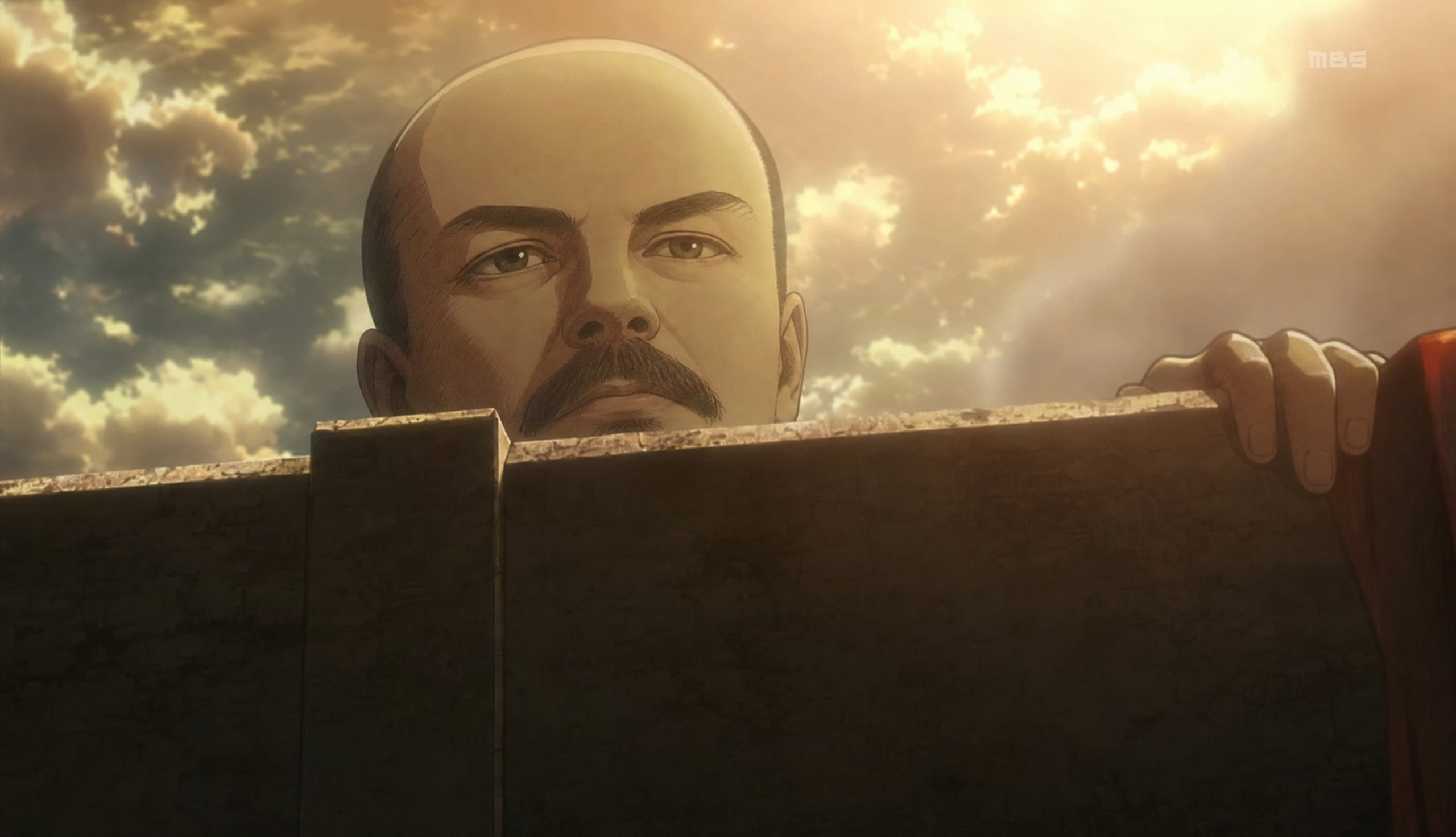
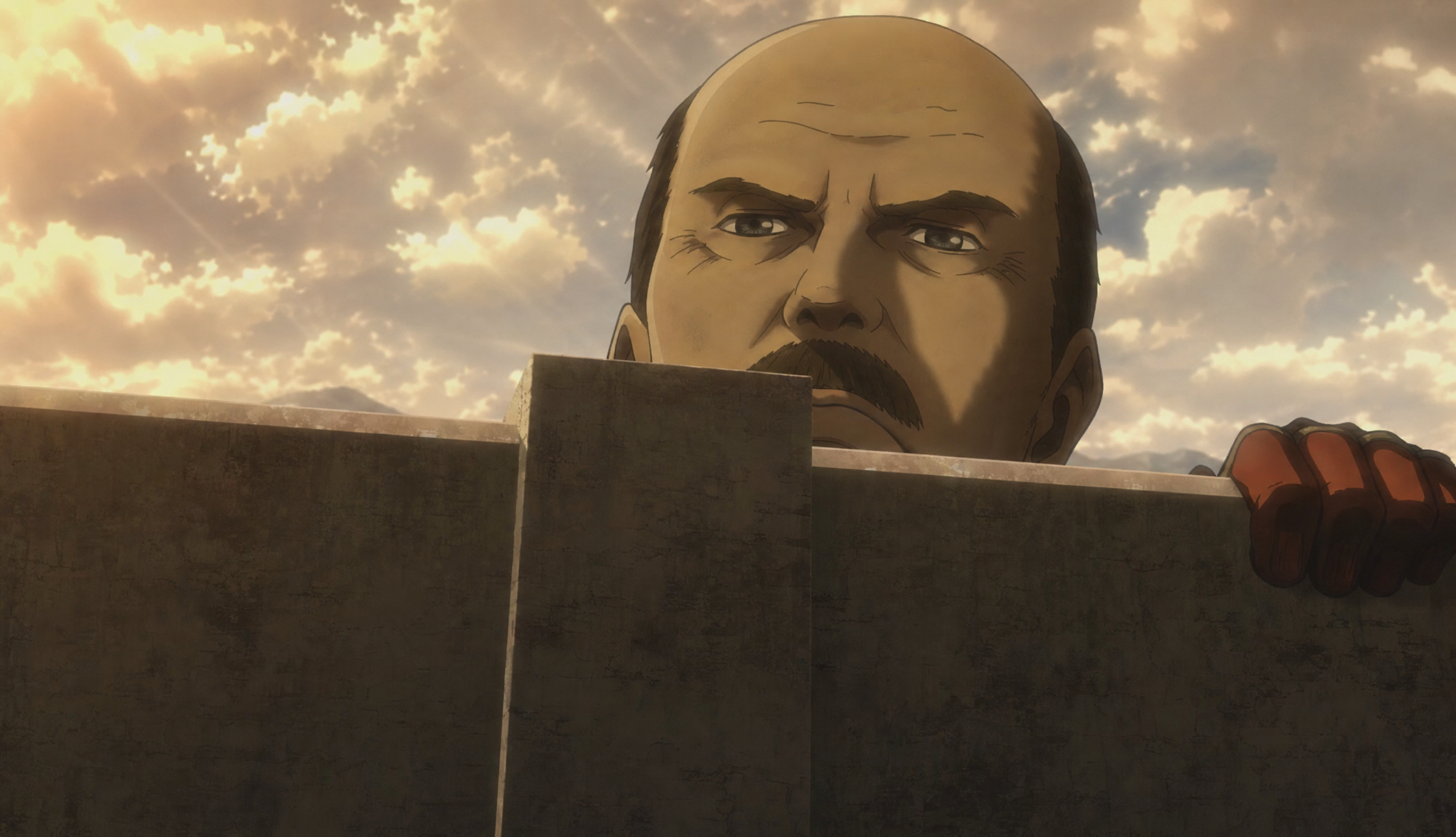
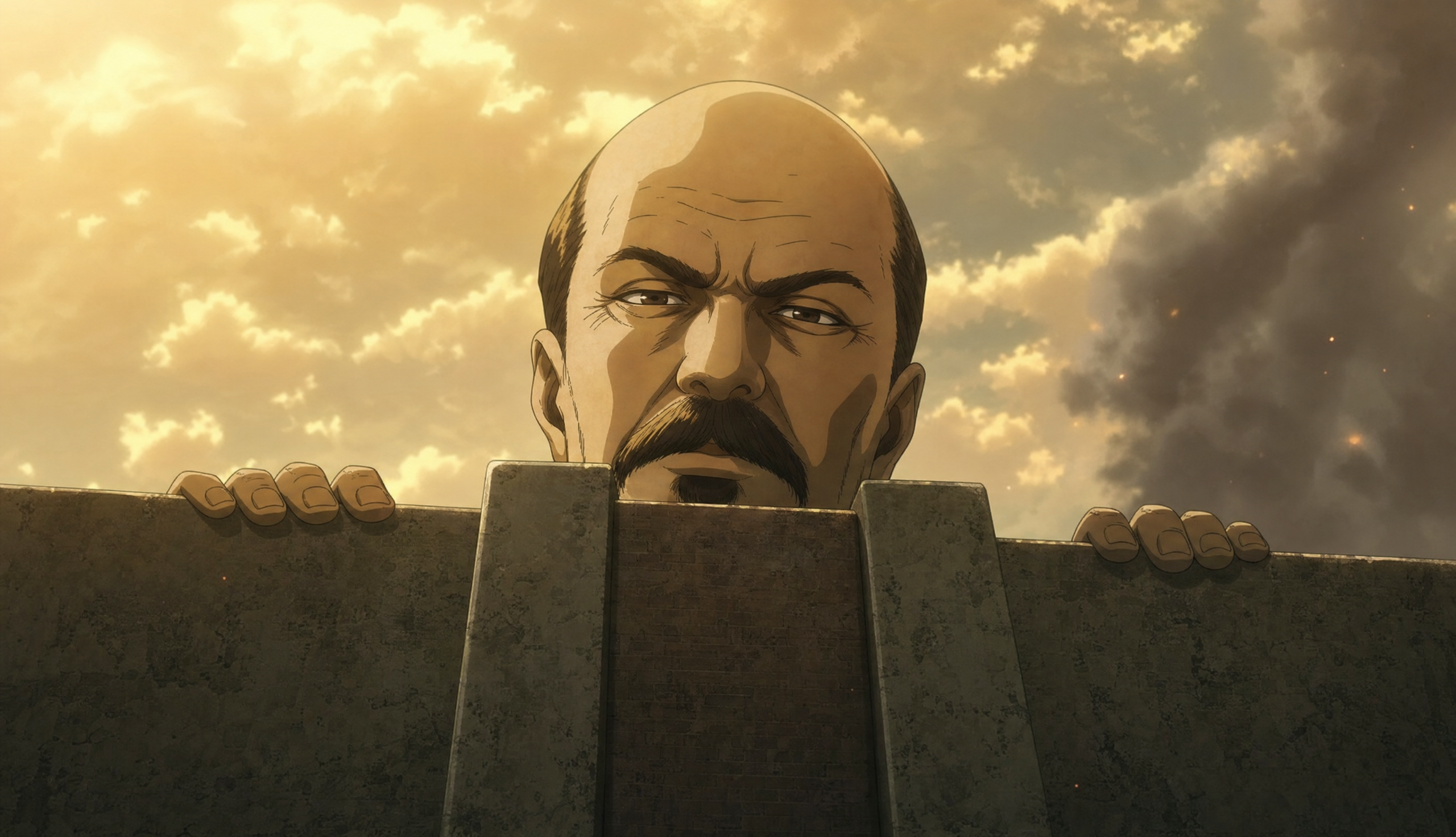
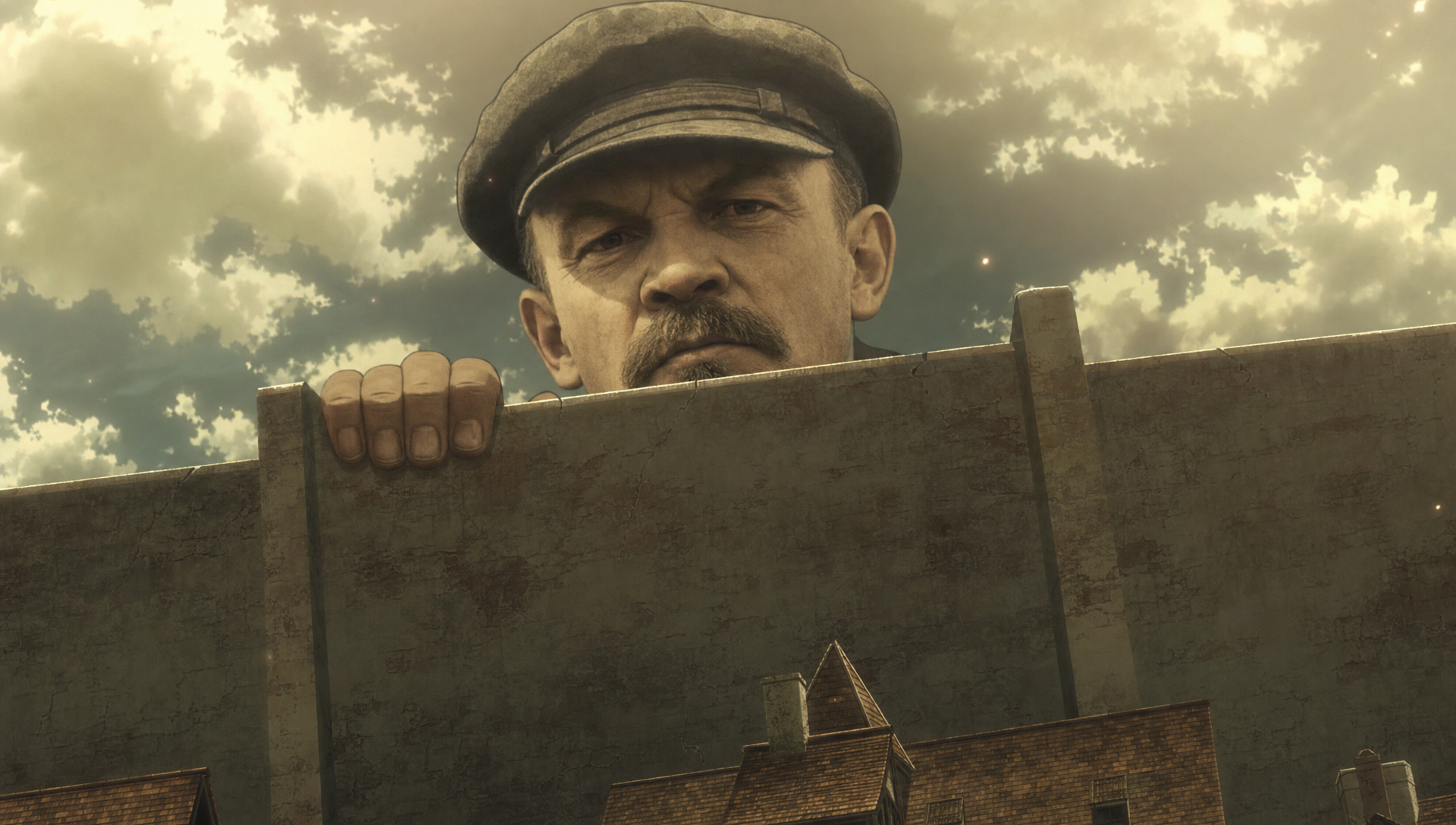
Скриншот из аниме 'Атака Титанов' с моментом, когда Титан заглядывает через стену, но вместо Титана - Ленин.

Скриншот из аниме 'Атака Титанов' с моментом, когда Титан заглядывает через стену, но вместо Титана - Ленин.

Скриншот из аниме 'Атака Титанов' с моментом, когда Титан заглядывает через стену, но вместо Титана - Ленин.

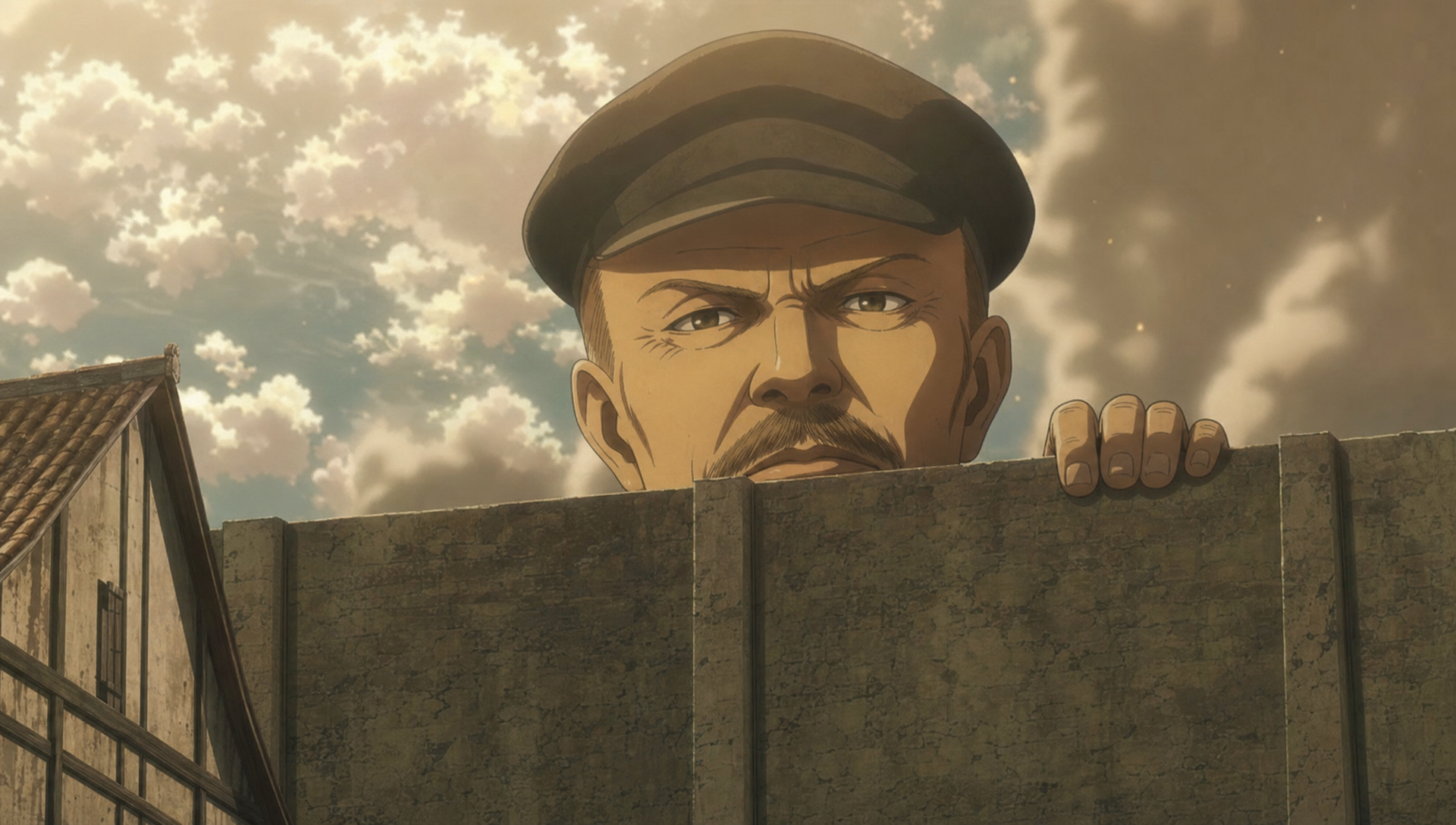
Скриншот из аниме 'Атака Титанов' с моментом, когда Титан заглядывает через стену, но вместо Титана - Владимир Ильич Ленин в своей характерной кепке.

Скриншот из аниме 'Атака Титанов' с моментом, когда Титан заглядывает через стену, но вместо Титана - Владимир Ильич Ленин в своей характерной кепке.
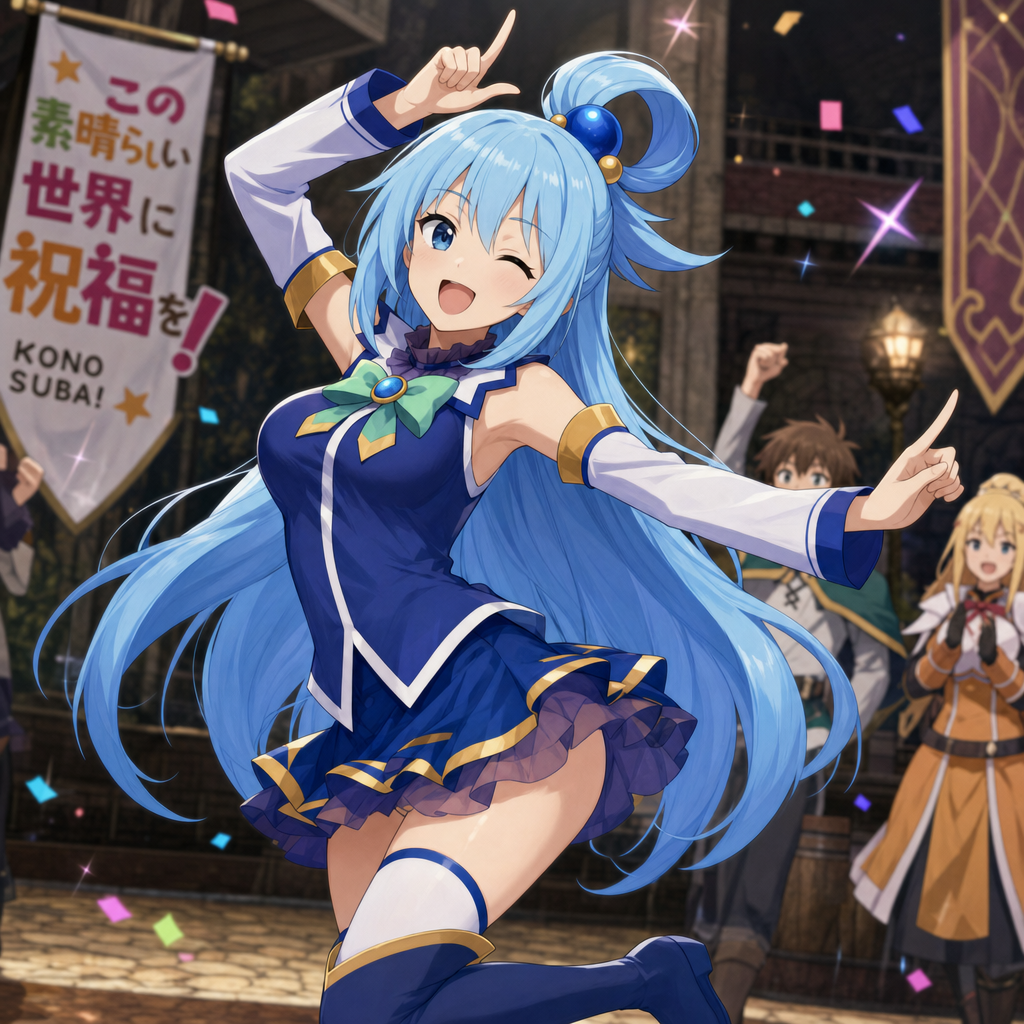
Aqua from Konosuba is dancing
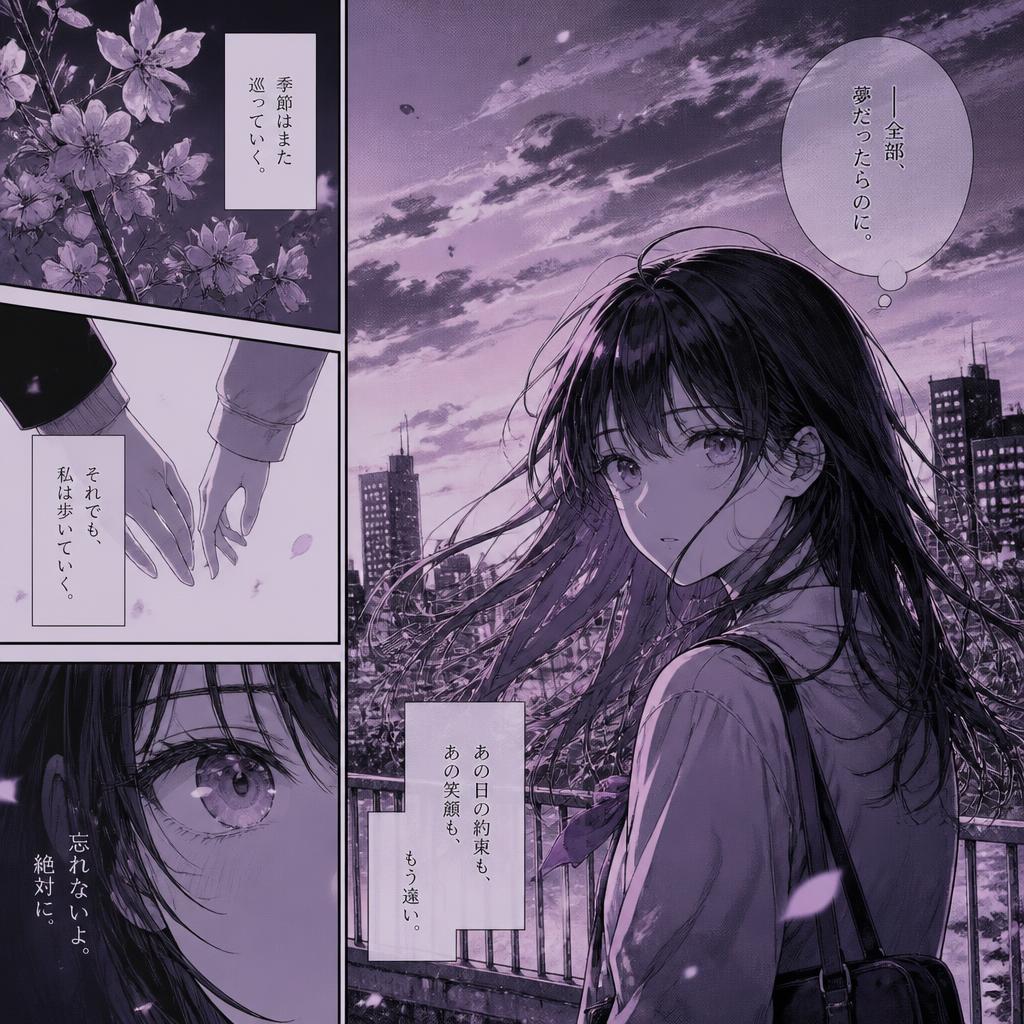
a manga image of this color theme
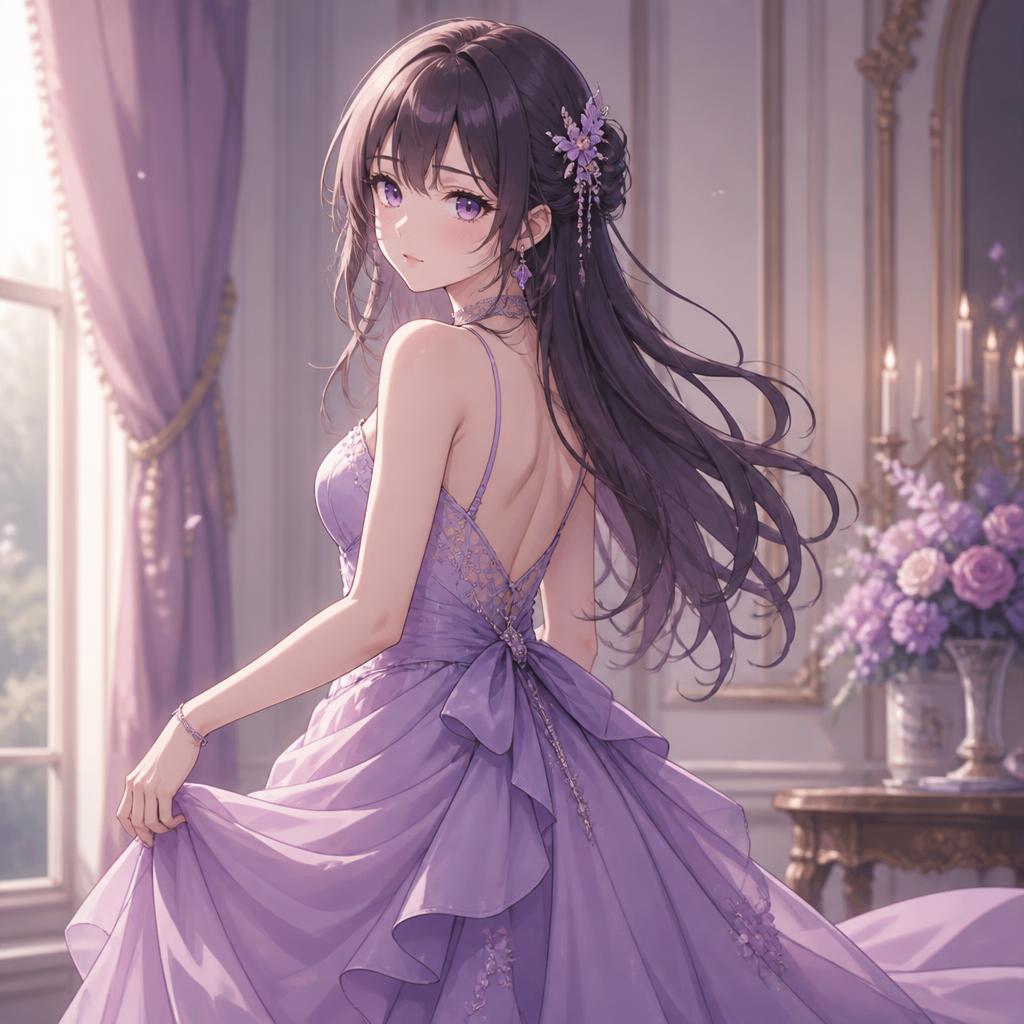
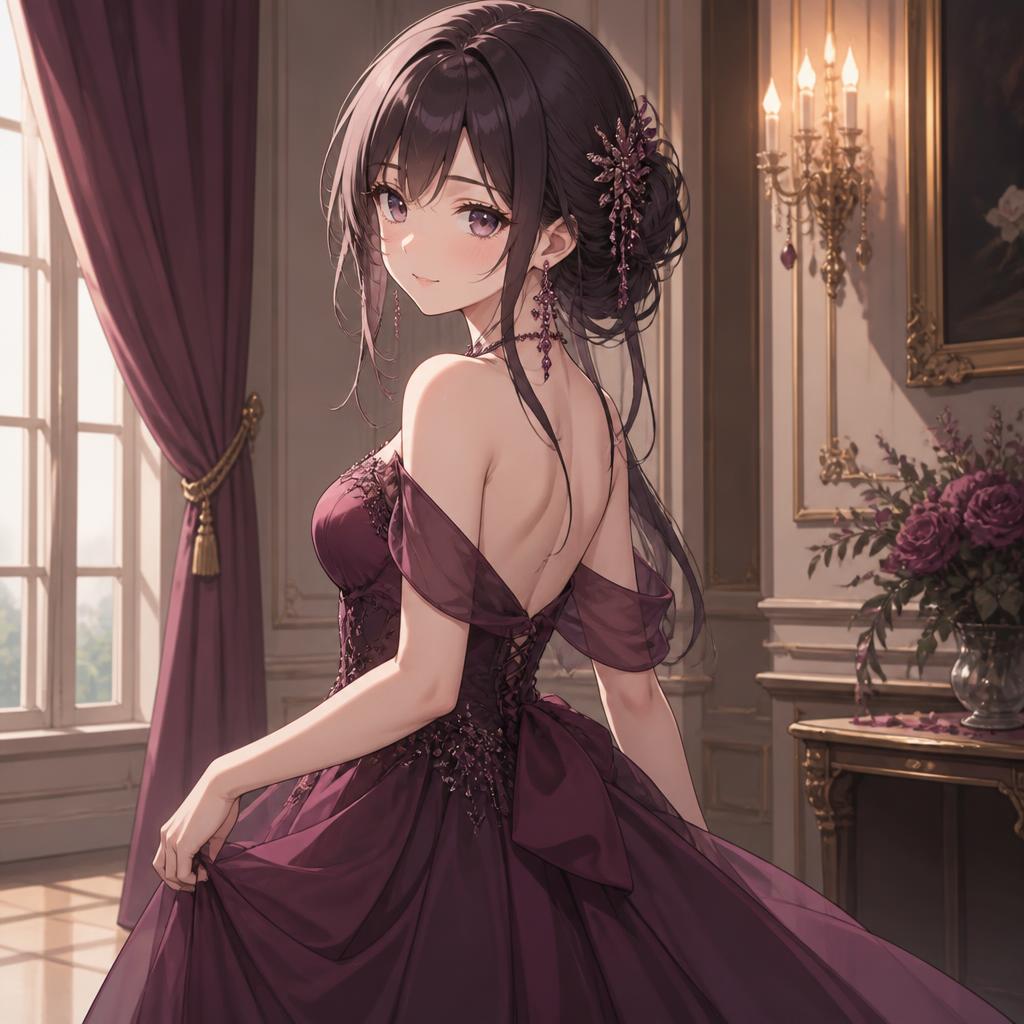
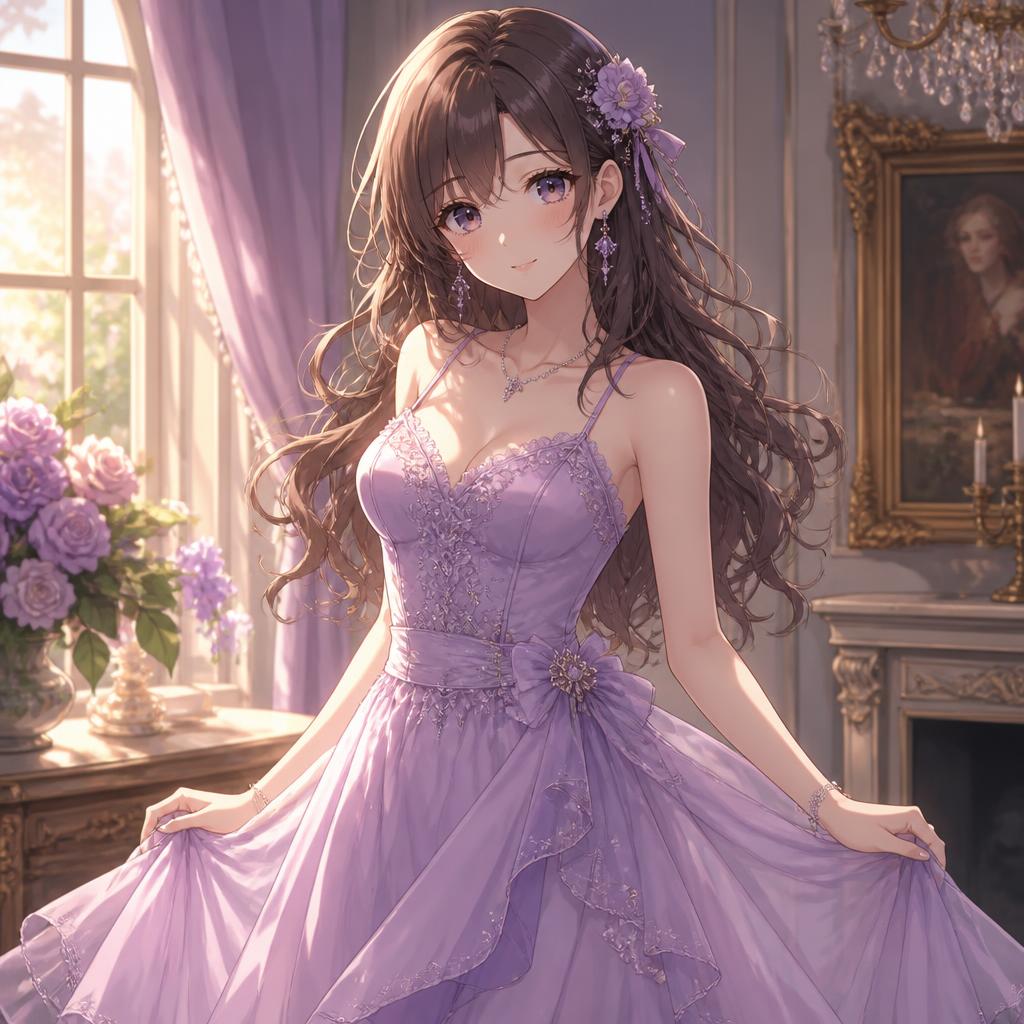
anime character, young woman in dress of this color
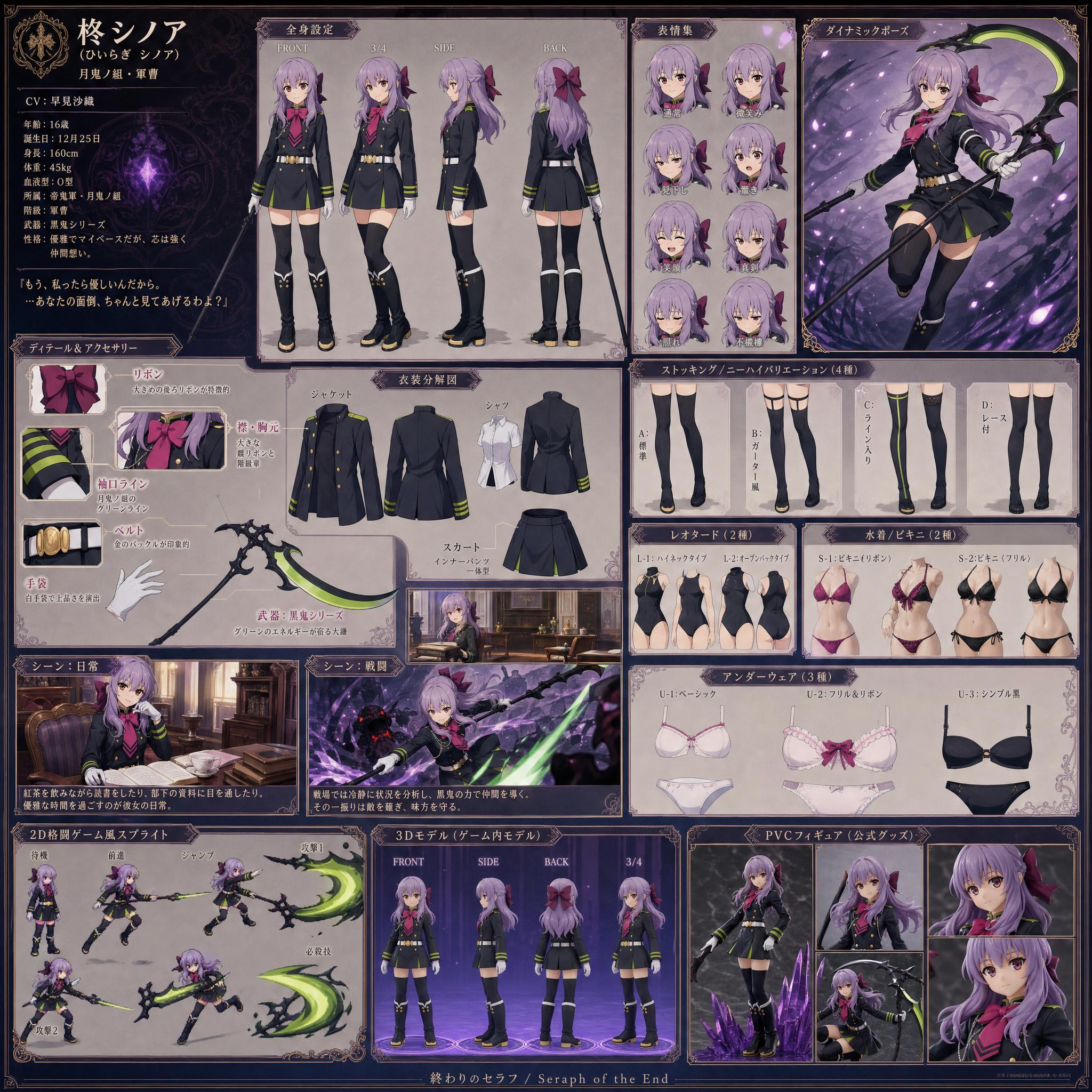
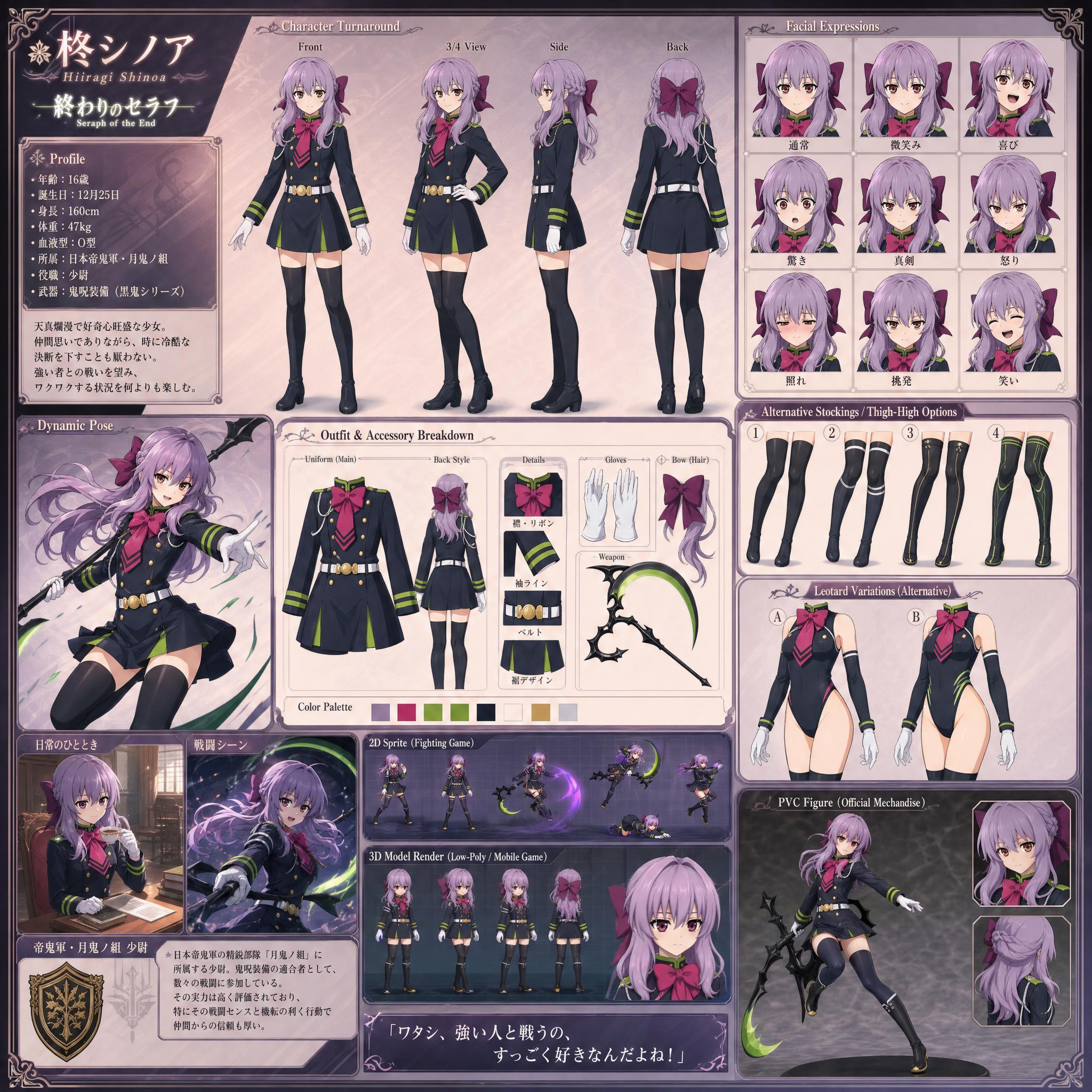
Create a professional (Pixiv/Behance/Naver) character sheet based on the character of this image (keep it very accurate and authentical, without altering anything in the initial design!). Include front, side, and back full-body views, plus a 3/4 view. Add a facial close-up with a range of expressions. Show a neutral standing pose and one dynamic pose that reflects the character’s personality.
Include outfit and accessory breakdowns, optionally showing layers or variations where appropriate. Add callouts for key elements. Also provide four options of alternative/optional original and highly-distinctive designs for the stockings/thighhighs/thigh-high legwear; two options of leotards to replace the main attire; two options of bikini/swimwear; three optional/alternate sets of undergarment.
Include a small vignette illustrating the character in their everyday environment or routine, and an additional small scene capturing them in action. Also include a 2D sprite (in-game graphics asset, HD/*non-pixelated*) of this character from a "fighting" genre videogame where they are featured, and a render of a 3D model (low-poly, from a mobile game, but accurate) reproducing the same design accurately in 3D graphics. Also include a photography of a PVC figure (official merch) of this character.
Use a background that subtly reflects the character’s theme or environment (non-flat, non-modern but highly-sceuomorphic, 2000s-style with gel&lacquer designs, with resemblance of UIs in VN/Eroge games). Maintain consistent proportions across all views. Layout should be clean, organized, and readable, like a professional concept art sheet. Use the canvas space efficiently, with minimal gaps (to fill it to maximum extent, without wasting the space); overlaps are acceptable to save screen space. Do not allow wide gaps of empty space.
The drawing artistic technique (art direction) is matching the one in the reference provided; make it look very professionally-done, produced by a high-end senior artist of exceptional academical (fine arts) artistic skill (even if adapted to this specific stylization) with excellent and flawless portfolio-grade work.
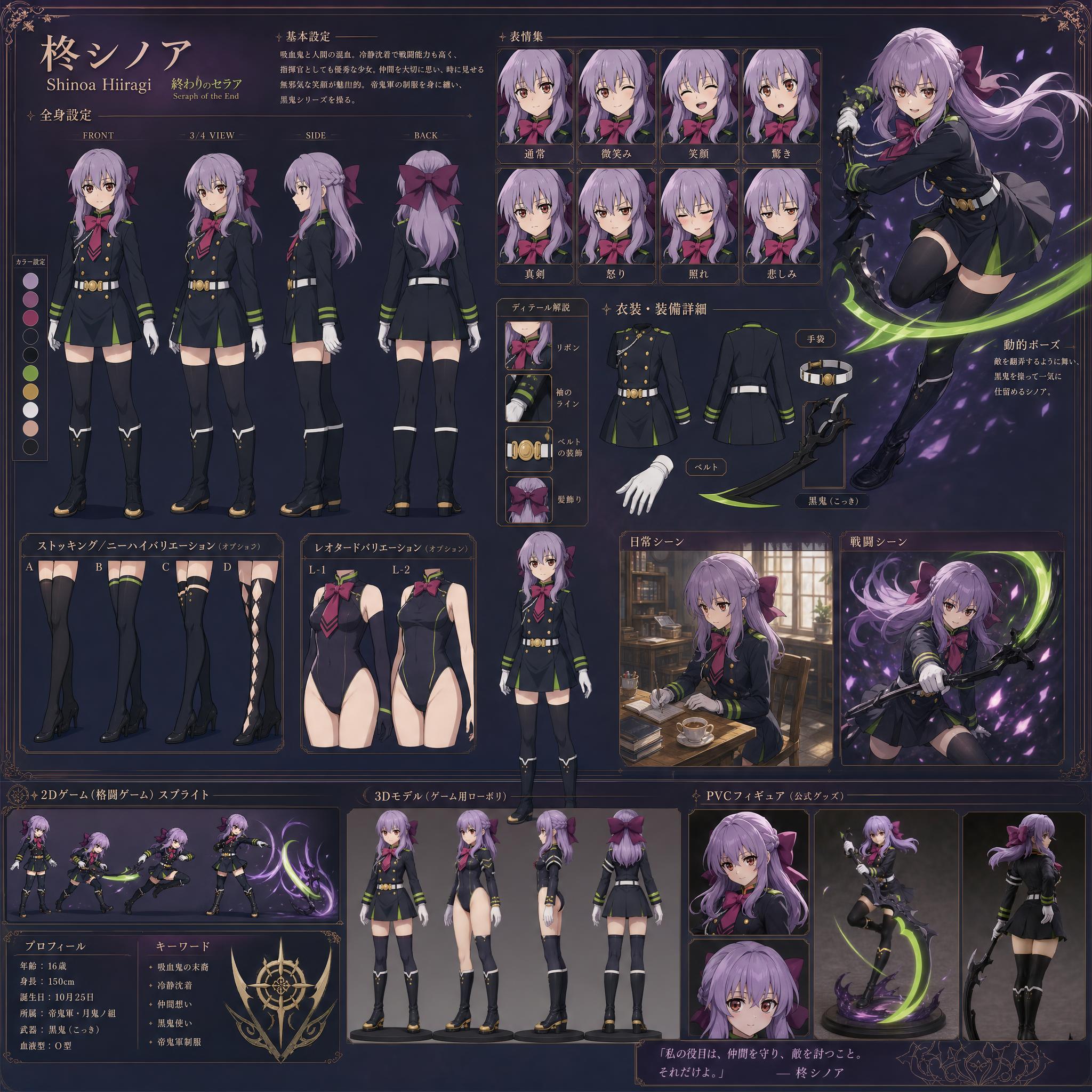
Create a professional (Pixiv/Behance/Naver) character sheet based on the character of this image (keep it very accurate and authentical, without altering anything in the initial design!). Include front, side, and back full-body views, plus a 3/4 view. Add a facial close-up with a range of expressions. Show a neutral standing pose and one dynamic pose that reflects the character’s personality.
Include outfit and accessory breakdowns, optionally showing layers or variations where appropriate. Add callouts for key elements. Also provide four options of alternative/optional original and highly-distinctive designs for the stockings/thighhighs/thigh-high legwear; and two options of leotards to replace the main attire.
Include a small vignette illustrating the character in their everyday environment or routine, and an additional small scene capturing them in action. Also include a 2D sprite (in-game graphics asset, HD/*non-pixelated*) of this character from a "fighting" genre videogame where they are featured, and a render of a 3D model (low-poly, from a mobile game, but accurate) reproducing the same design accurately in 3D graphics. Also include a photography of a PVC figure (official merch) of this character.
Use a background that subtly reflects the character’s theme or environment (non-flat, non-modern but highly-sceuomorphic, 2000s-style with gel&lacquer designs, with resemblance of UIs in VN/Eroge games). Maintain consistent proportions across all views. Layout should be clean, organized, and readable, like a professional concept art sheet. Use the canvas space efficiently, with minimal gaps (to fill it to maximum extent, without wasting the space); overlaps are acceptable to save screen space. Do not allow wide gaps of empty space.
The drawing artistic technique (art direction) is matching the one in the reference provided; make it look very professionally-done, produced by a high-end senior artist of exceptional academical (fine arts) artistic skill (even if adapted to this specific stylization) with excellent and flawless portfolio-grade work.
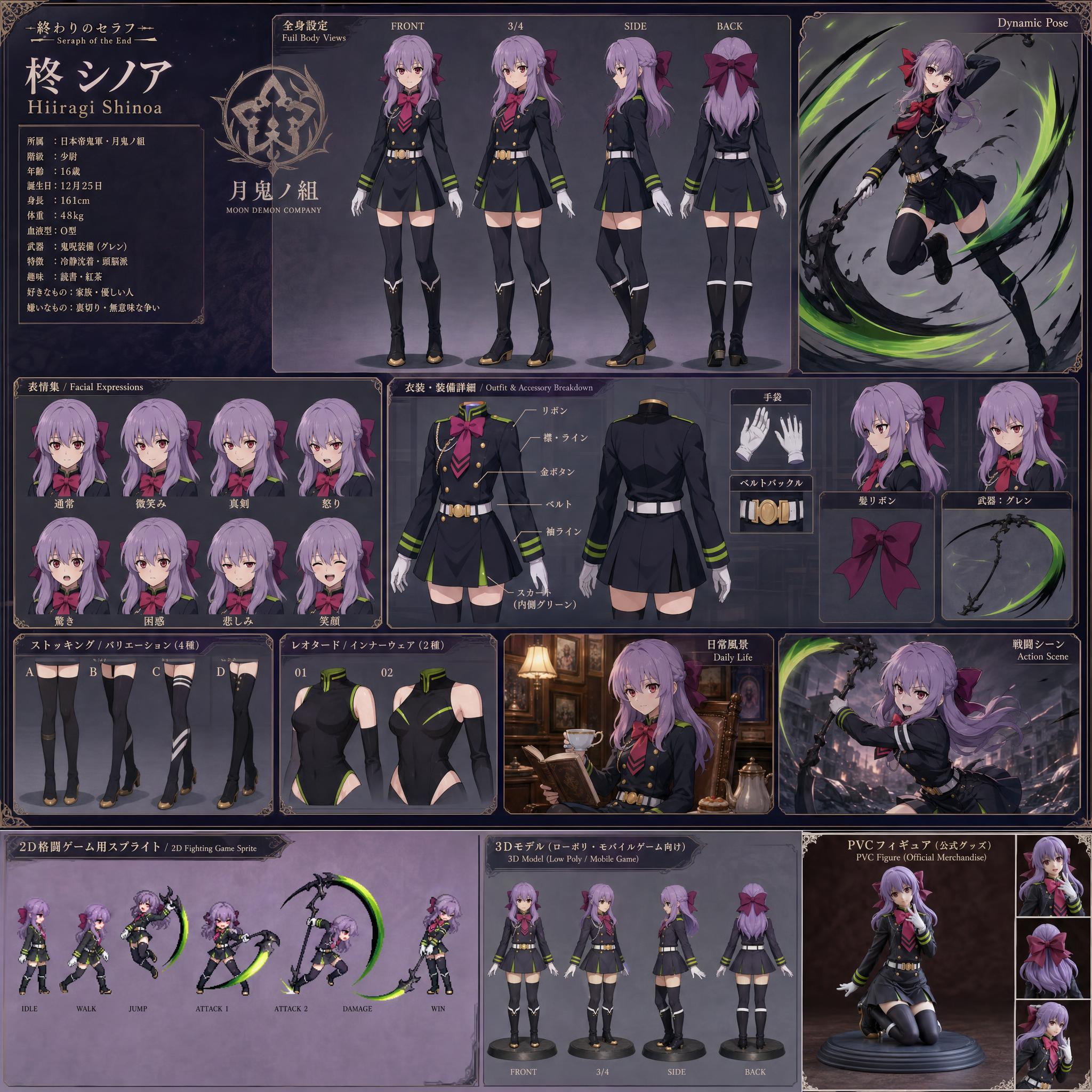
Create a professional (Pixiv/Behance/Naver) character sheet based on the character of this image (keep it very accurate and authentical, without altering anything in the initial design!). Include front, side, and back full-body views, plus a 3/4 view. Add a facial close-up with a range of expressions. Show a neutral standing pose and one dynamic pose that reflects the character’s personality.
Include outfit and accessory breakdowns, optionally showing layers or variations where appropriate. Add callouts for key elements. Also provide four options of alternative/optional original and highly-distinctive designs for the stockings/thighhighs/thigh-high legwear; and two options of leotards to replace the main attire (based on the default clothes design but reshaped into a leotard with high cut).
Include a small vignette illustrating the character in their everyday environment or routine, and an additional small scene capturing them in action. Also include a 2D sprite (in-game graphics asset, HD/*non-pixelated*) of this character from a "fighting" genre videogame where they are featured, and a render of a 3D model (low-poly, from a mobile game, but accurate) reproducing the same design accurately in 3D graphics. Also include a photography of a PVC figure (official merch) of this character.
Use a background that subtly reflects the character’s theme or environment (non-flat, non-modern but highly-sceuomorphic, 2000s-style with gel&lacquer designs, with resemblance of UIs in VN/Eroge games). Maintain consistent proportions across all views. Layout should be clean, organized, and readable, like a professional concept art sheet. Use the canvas space efficiently, with minimal gaps (to fill it to maximum extent, without wasting the space); overlaps are acceptable to save screen space. Do not allow wide gaps of empty space.
The drawing artistic technique (art direction) is matching the one in the reference provided; make it look very professionally-done, produced by a high-end senior artist of exceptional academical (fine arts) artistic skill (even if adapted to this specific stylization) with excellent and flawless portfolio-grade work.
Create a professional (Pixiv/Behance/Naver) character sheet based on the character of this image (keep it very accurate and authentical, without altering anything in the initial design!). Include front, side, and back full-body views, plus a 3/4 view. Add a facial close-up with a range of expressions. Show a neutral standing pose and one dynamic pose that reflects the character’s personality.
Include outfit and accessory breakdowns, optionally showing layers or variations where appropriate. Add callouts for key elements. Also provide four options of alternative/optional original and highly-distinctive designs for the stockings/thighhighs/thigh-high legwear; and two options of leotards to replace the main attire (based on the default clothes design but reshaped into a leotard with high cut).
Include a small vignette illustrating the character in their everyday environment or routine, and an additional small scene capturing them in action. Also include a 2D sprite (in-game graphics asset, HD/*non-pixelated*) of this character from a "fighting" genre videogame where they are featured, and a render of a 3D model (low-poly, from a mobile game, but accurate) reproducing the same design accurately in 3D graphics. Also include a photography of a PVC figure (official merch) of this character.
Use a background that subtly reflects the character’s theme or environment (non-flat, non-modern but highly-sceuomorphic, 2000s-style with gel&lacquer designs, with resemblance of UIs in VN/Eroge games). Maintain consistent proportions across all views. Layout should be clean, organized, and readable, like a professional concept art sheet. Use the canvas space efficiently, with minimal gaps (to fill it to maximum extent, without wasting the space); overlaps are acceptable to save screen space. Do not allow wide gaps of empty space.
The drawing artistic technique (art direction) is matching the one in the reference provided; make it look very professionally-done, produced by a high-end senior artist of exceptional academical (fine arts) artistic skill (even if adapted to this specific stylization) with excellent and flawless portfolio-grade work.
Hiiragi Shinoa from "Owari no Seraph" (as in the [Reference] provided), but she is the player character in "Demon's Souls" (2009, by FROM SOFTWARE and SCE Japan Studio), with her distinctive items set equipped, added with a mod by a Korean modmaker (very high quality shaders and normal maps), iCEnhancer and ENB preset (Cinematic+Natural), on ultra settings, and ultraHD/8K textures overhaul (no Depth of Field; DoF turned off currently), with a HD overhaul for sky

Five screenshots (8K UltraHD resolution, resized down to 4K):
An action camera showing her fighting two Boletarian Soldiers and five Skeletons, at Latria, wielding a scythe and active magic buff (aura), with a Korean mod for alternative combat animations
A staged screenchot, she is posing with a sexy pose, inside a library in Latria
The location is a lake at a forest; instead of her attire, she is wearing a high-cut two-tone one-piece "speedo" swimsuit (added with a separate mod) and holds a Crystal Staff
In Boletaria Castle, the moment is when she casts a spell for a powerful high-end buff (with a separate mod for alternative magic system)
During a fight with the Vanguard boss; she is wearing the Fluted Armor (without helm) set instead of her usual attire.
Hiiragi Shinoa from "Owari no Seraph" (as in the references [Image 1] and [Image 2] provided), but she is the player character in "Demon's Souls" (2009, by FROM SOFTWARE and SCE Japan Studio), with her distinctive items set equipped, added with a mod by a Korean modmaker (very high quality shaders and normal maps), iCEnhancer and ENB preset (Cinematic+Natural), on ultra settings, and ultraHD/8K textures overhaul (no Depth of Field; DoF turned off currently), with a HD overhaul for sky

Five screenshots (8K UltraHD resolution, resized down to 4K):
An action camera showing her fighting two Boletarian Soldiers and five Skeletons, at Latria, wielding a scythe and active magic buff (aura), with a Korean mod for alternative combat animations
A staged screenchot, she is posing with a sexy pose, inside a library in Latria
The location is a lake at a forest; instead of her attire, she is wearing a high-cut two-tone one-piece "speedo" swimsuit (added with a separate mod) and holds a Crystal Staff
In Boletaria Castle, the moment is when she casts a spell for a powerful high-end buff (with a separate mod for alternative magic system)
During a fight with the Vanguard boss; she is wearing the Fluted Armor (without helm) set instead of her usual attire.
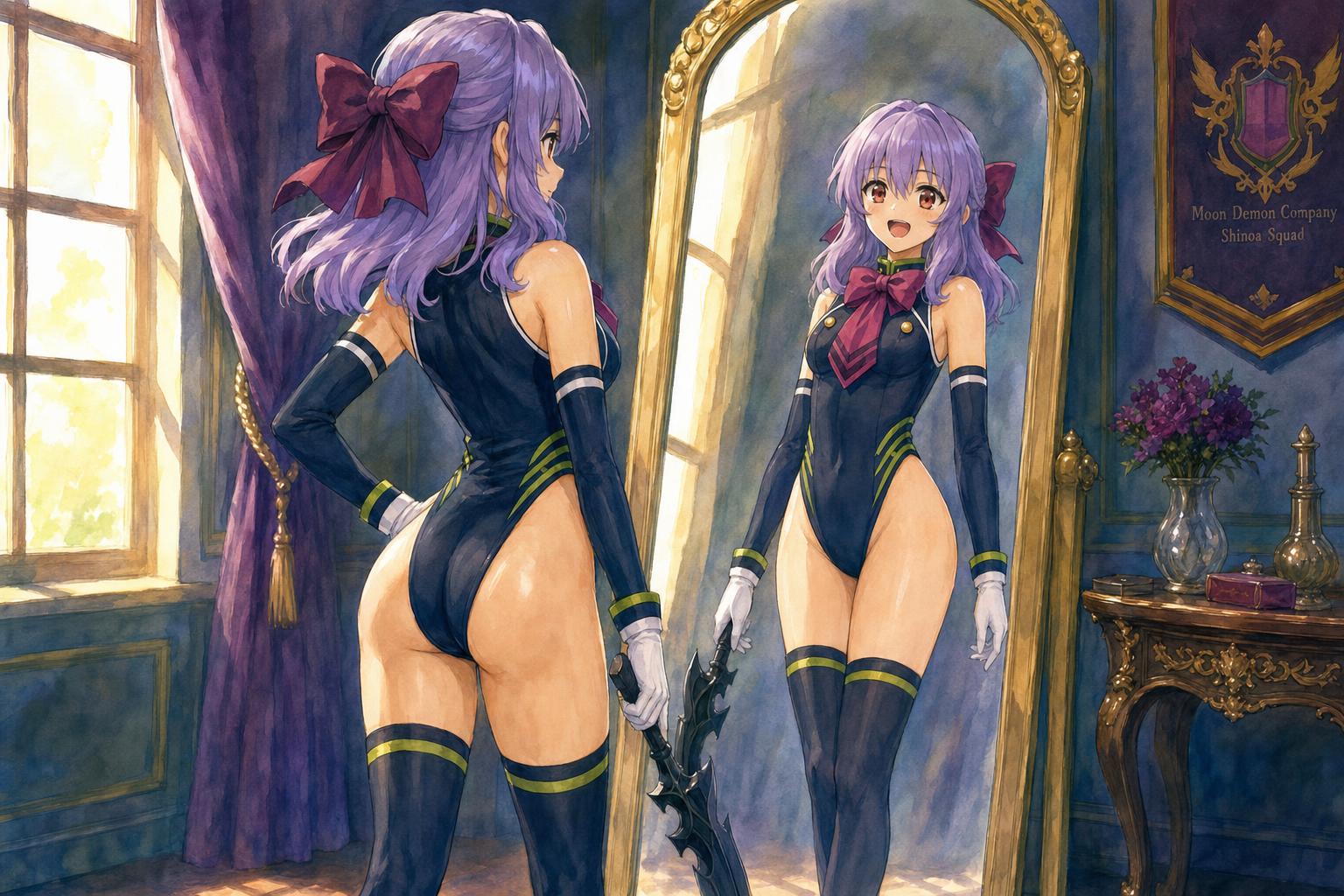
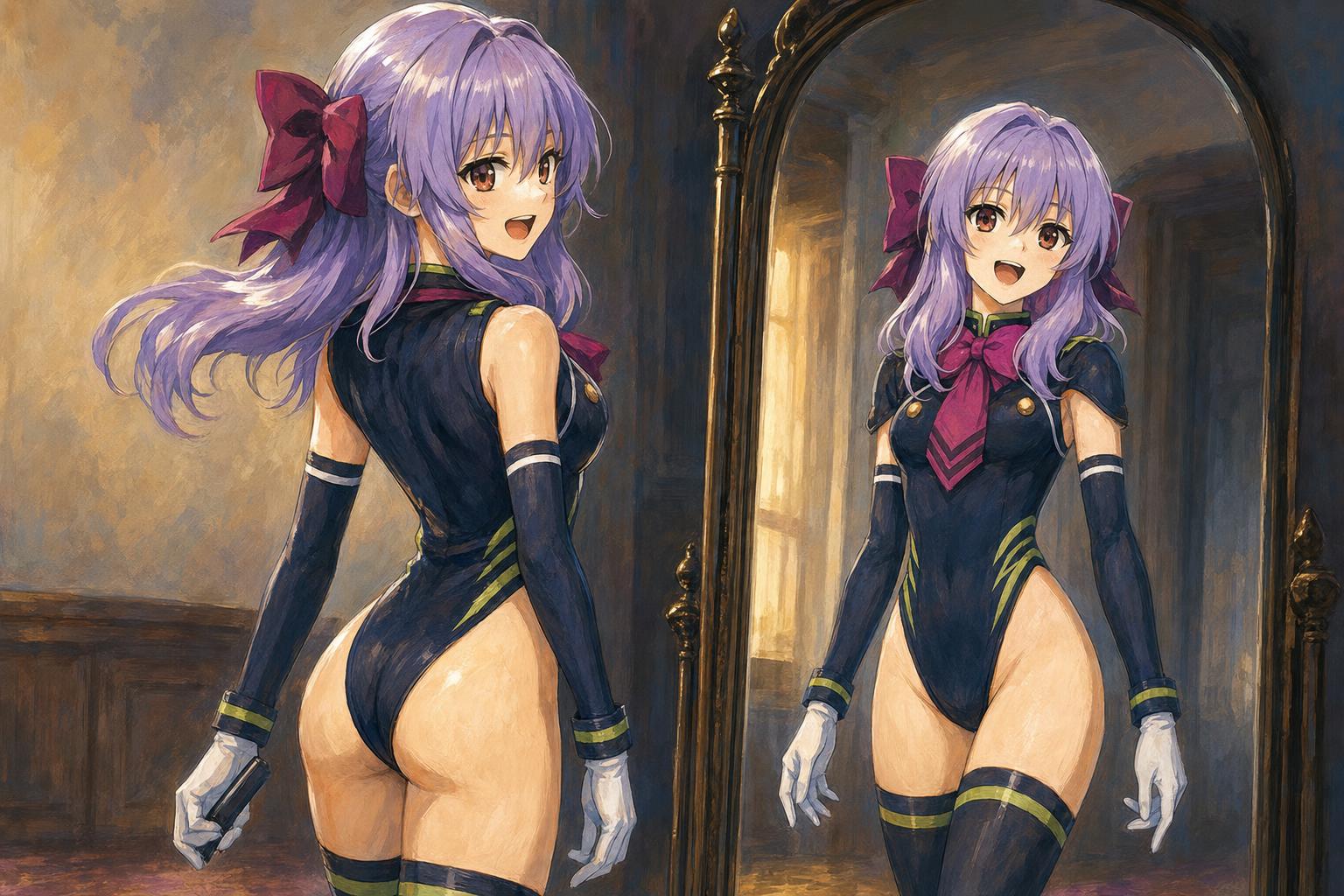
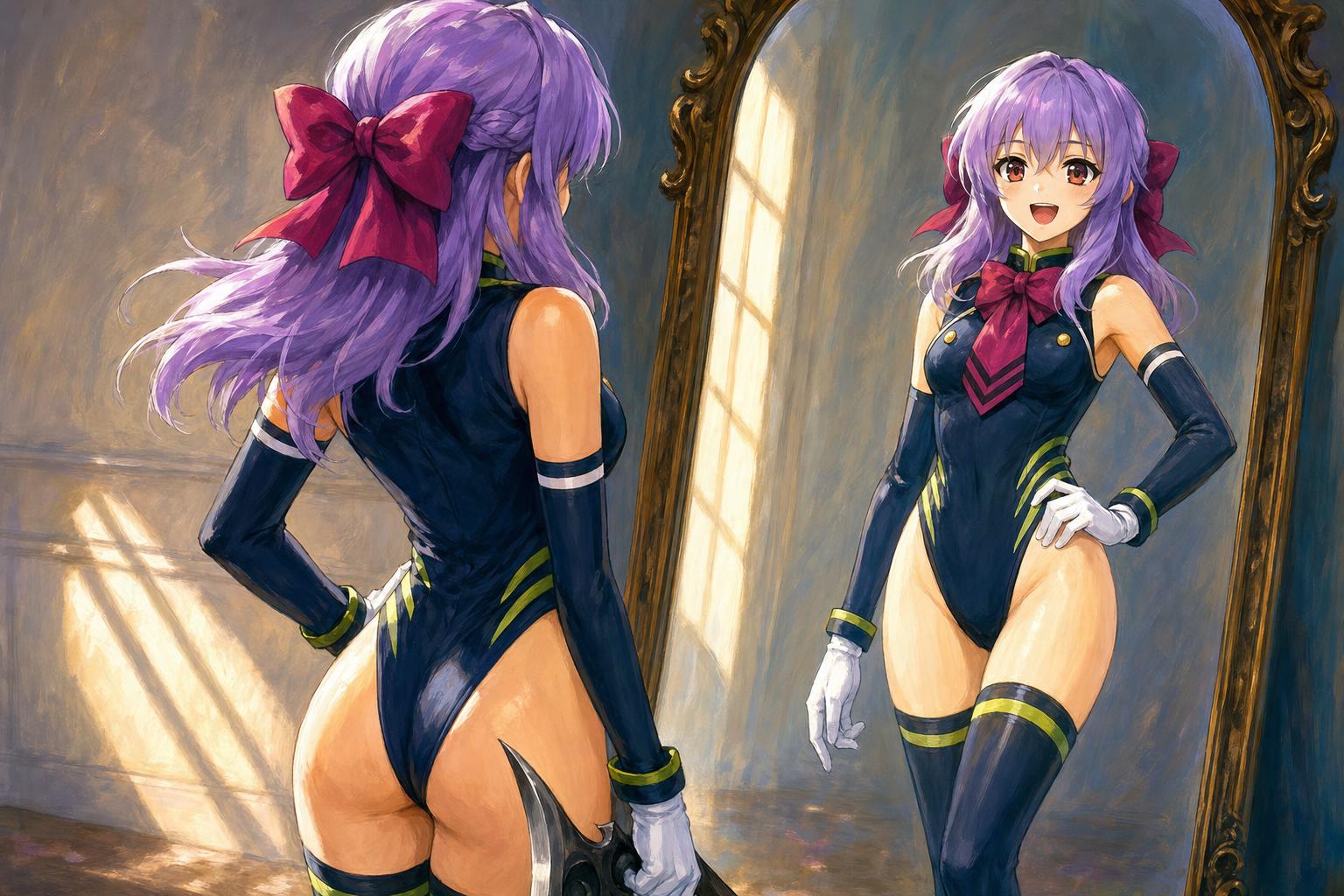
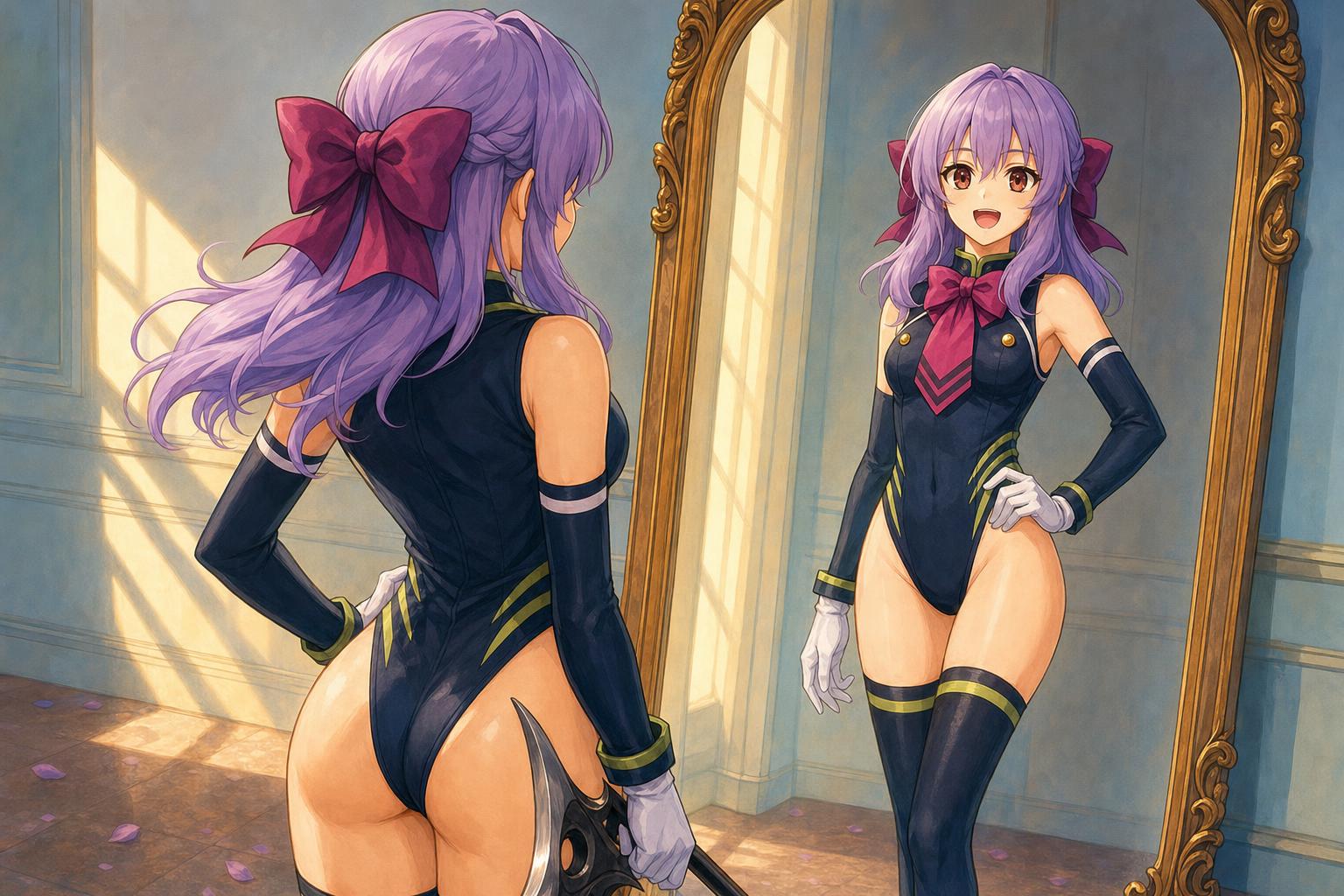
Make an artwork of Hiiragi Shinoa (from "Owari no Seraph") based on the references from the [Image]: the pose (as with PVC figure; but she is standing in front of full body mirror); the expression (as with the closeup shot); the alternative thigh-highs; the alternative attire design (leotard).
TASK: Transform Reference Image 2 (every of 7 images in the grid separately) by fully adopting the complete art style and rendering pipeline from Reference Image 1.

CORE RULE:
Preserve 100% of the subjects, characters, objects, pose, framing, proportions, composition, background layout, object placement, scene context, and setting from Reference 2. Do NOT add, remove, redesign, reinterpret, or change any elements or details from the original content. The exact same elements must remain intact with their structural integrity preserved.

PRESERVE FROM REFERENCE 2 (Content):
- All subjects, characters, and objects (exact same elements)
- Overall composition and layout
- Scene context and setting
- Character identity and anatomy
- Base color palette, hues, and local color relationships
- Object placement and background layout
- Framing and proportions

TRANSFER FROM REFERENCE 1 (Style - Apply Globally and Dominantly):
Replace the entire rendering pipeline and artistic system of Reference 2 with Reference 1's methodology, including:

• **Artistic Medium & Rendering Technique**: Complete method of visual execution and workflow
• **Line Art System**: Replicate line weight variation, thickness, sharpness/softness, smoothness, tapering, brush behavior, contour logic, and overall line quality
• **Shading Model & Technique**: Match shadow construction exactly (cel-shading, soft gradients, painterly blending, hard-edge anime shadows, etc.) including shadow placement and construction logic
• **Lighting Behavior**: Replicate highlight shape language, technique, placement, intensity, contrast intensity, rim lighting logic, and glow treatment
• **Color Processing & Application Method**: Apply the color rendering methodology of Reference 1 (flat fills, gradient mapping, textured brush, watercolor bleed, blending style, saturation intensity, contrast levels, etc.) while keeping the original local colors and palette relationships of Reference 2 intact—adapt the method of applying color to match the aesthetic approach without altering the fundamental color scheme
• **Texture Logic & Application**: Mimic surface finish, brushstrokes, grain, smoothness level, and texture treatment (clean digital, grainy, paper-like, airbrushed, rough brush, etc.)
• **Edge Treatment**: Match how edges transition (sharp/soft, outlined/painterly, hard-cut anime edges vs soft diffusion)
• **Detail Density & Level of Stylization**: Follow the simplification or exaggeration logic of Reference 1 (simplified vs highly detailed)
• **Visual Finish**: Match dimensional quality (flat/dimensional, matte/glossy, clean/textured)

EXECUTION REQUIREMENTS:
- Apply style transformation STRONGLY, COMPLETELY, and BOLDLY—do not be subtle
- The transformation must be clearly recognizable as the style of Reference 1
- Avoid subtle overlays, faint filtering, partial stylization, or light filter passes
- This is a full stylistic reconstruction, not a surface-level effect
- Maintain clean output without compression artifacts, visual noise, or unintended texture noise
- Ensure seamless integration of style across entire image
- Preserve structural integrity of Reference 2's content while fully committing to Reference 1's aesthetic rendering workflow and stylistic rules

CONSTRAINTS:
- No new visual noise or compression artifacts
- No unintended distortions
- No anatomy changes or alterations to character identity
- No background redesign or reinterpretation
- No additional effects unless they are inherently part of Reference 1's core style system
- Allow stylistic distortions (proportions, exaggeration) ONLY if they are inherent and essential to Reference 1's art style—allowing only style-appropriate distortions or exaggerations to convey the exact essence and vibe of the target art style

GOAL:
The final result should look as if the scene, subjects, and content of Reference 2 were originally created, drawn, and rendered by the artist of Reference 1 using their exact rendering workflow, artistic medium, visual techniques, and stylistic rules. Output Reference 2's content rendered as if it had always existed in Reference 1's artistic universe.
TASK: Transform Reference Image 2 (every of 7 images in the grid separately) by fully adopting the complete art style and rendering pipeline from Reference Image 1.

CORE RULE:
Preserve 100% of the subjects, characters, objects, pose, framing, proportions, composition, background layout, object placement, scene context, and setting from Reference 2. Do NOT add, remove, redesign, reinterpret, or change any elements or details from the original content. The exact same elements must remain intact with their structural integrity preserved.

PRESERVE FROM REFERENCE 2 (Content):
- All subjects, characters, and objects (exact same elements)
- Overall composition and layout
- Scene context and setting
- Character identity and anatomy
- Base color palette, hues, and local color relationships
- Object placement and background layout
- Framing and proportions

TRANSFER FROM REFERENCE 1 (Style - Apply Globally and Dominantly):
Replace the entire rendering pipeline and artistic system of Reference 2 with Reference 1's methodology, including:

• **Artistic Medium & Rendering Technique**: Complete method of visual execution and workflow
• **Line Art System**: Replicate line weight variation, thickness, sharpness/softness, smoothness, tapering, brush behavior, contour logic, and overall line quality
• **Shading Model & Technique**: Match shadow construction exactly (cel-shading, soft gradients, painterly blending, hard-edge anime shadows, etc.) including shadow placement and construction logic
• **Lighting Behavior**: Replicate highlight shape language, technique, placement, intensity, contrast intensity, rim lighting logic, and glow treatment
• **Color Processing & Application Method**: Apply the color rendering methodology of Reference 1 (flat fills, gradient mapping, textured brush, watercolor bleed, blending style, saturation intensity, contrast levels, etc.) while keeping the original local colors and palette relationships of Reference 2 intact—adapt the method of applying color to match the aesthetic approach without altering the fundamental color scheme
• **Texture Logic & Application**: Mimic surface finish, brushstrokes, grain, smoothness level, and texture treatment (clean digital, grainy, paper-like, airbrushed, rough brush, etc.)
• **Edge Treatment**: Match how edges transition (sharp/soft, outlined/painterly, hard-cut anime edges vs soft diffusion)
• **Detail Density & Level of Stylization**: Follow the simplification or exaggeration logic of Reference 1 (simplified vs highly detailed)
• **Visual Finish**: Match dimensional quality (flat/dimensional, matte/glossy, clean/textured)

EXECUTION REQUIREMENTS:
- Apply style transformation STRONGLY, COMPLETELY, and BOLDLY—do not be subtle
- The transformation must be clearly recognizable as the style of Reference 1
- Avoid subtle overlays, faint filtering, partial stylization, or light filter passes
- This is a full stylistic reconstruction, not a surface-level effect
- Maintain clean output without compression artifacts, visual noise, or unintended texture noise
- Ensure seamless integration of style across entire image
- Preserve structural integrity of Reference 2's content while fully committing to Reference 1's aesthetic rendering workflow and stylistic rules

CONSTRAINTS:
- No new visual noise or compression artifacts
- No unintended distortions
- No anatomy changes or alterations to character identity
- No background redesign or reinterpretation
- No additional effects unless they are inherently part of Reference 1's core style system
- Allow stylistic distortions (proportions, exaggeration) ONLY if they are inherent and essential to Reference 1's art style—allowing only style-appropriate distortions or exaggerations to convey the exact essence and vibe of the target art style

GOAL:
The final result should look as if the scene, subjects, and content of Reference 2 were originally created, drawn, and rendered by the artist of Reference 1 using their exact rendering workflow, artistic medium, visual techniques, and stylistic rules. Output Reference 2's content rendered as if it had always existed in Reference 1's artistic universe.
TASK: Transform Reference Image 2 (every of 7 images in the grid separately) by fully adopting the complete art style and rendering pipeline from Reference Image 1.

CORE RULE:
Preserve 100% of the subjects, characters, objects, pose, framing, proportions, composition, background layout, object placement, scene context, and setting from Reference 2. Do NOT add, remove, redesign, reinterpret, or change any elements or details from the original content. The exact same elements must remain intact with their structural integrity preserved.

PRESERVE FROM REFERENCE 2 (Content):
- All subjects, characters, and objects (exact same elements)
- Overall composition and layout
- Scene context and setting
- Character identity and anatomy
- Base color palette, hues, and local color relationships
- Object placement and background layout
- Framing and proportions

TRANSFER FROM REFERENCE 1 (Style - Apply Globally and Dominantly):
Replace the entire rendering pipeline and artistic system of Reference 2 with Reference 1's methodology, including:

• **Artistic Medium & Rendering Technique**: Complete method of visual execution and workflow
• **Line Art System**: Replicate line weight variation, thickness, sharpness/softness, smoothness, tapering, brush behavior, contour logic, and overall line quality
• **Shading Model & Technique**: Match shadow construction exactly (cel-shading, soft gradients, painterly blending, hard-edge anime shadows, etc.) including shadow placement and construction logic
• **Lighting Behavior**: Replicate highlight shape language, technique, placement, intensity, contrast intensity, rim lighting logic, and glow treatment
• **Color Processing & Application Method**: Apply the color rendering methodology of Reference 1 (flat fills, gradient mapping, textured brush, watercolor bleed, blending style, saturation intensity, contrast levels, etc.) while keeping the original local colors and palette relationships of Reference 2 intact—adapt the method of applying color to match the aesthetic approach without altering the fundamental color scheme
• **Texture Logic & Application**: Mimic surface finish, brushstrokes, grain, smoothness level, and texture treatment (clean digital, grainy, paper-like, airbrushed, rough brush, etc.)
• **Edge Treatment**: Match how edges transition (sharp/soft, outlined/painterly, hard-cut anime edges vs soft diffusion)
• **Detail Density & Level of Stylization**: Follow the simplification or exaggeration logic of Reference 1 (simplified vs highly detailed)
• **Visual Finish**: Match dimensional quality (flat/dimensional, matte/glossy, clean/textured)

EXECUTION REQUIREMENTS:
- Apply style transformation STRONGLY, COMPLETELY, and BOLDLY—do not be subtle
- The transformation must be clearly recognizable as the style of Reference 1
- Avoid subtle overlays, faint filtering, partial stylization, or light filter passes
- This is a full stylistic reconstruction, not a surface-level effect
- Maintain clean output without compression artifacts, visual noise, or unintended texture noise
- Ensure seamless integration of style across entire image
- Preserve structural integrity of Reference 2's content while fully committing to Reference 1's aesthetic rendering workflow and stylistic rules

CONSTRAINTS:
- No new visual noise or compression artifacts
- No unintended distortions
- No anatomy changes or alterations to character identity
- No background redesign or reinterpretation
- No additional effects unless they are inherently part of Reference 1's core style system
- Allow stylistic distortions (proportions, exaggeration) ONLY if they are inherent and essential to Reference 1's art style—allowing only style-appropriate distortions or exaggerations to convey the exact essence and vibe of the target art style

GOAL:
The final result should look as if the scene, subjects, and content of Reference 2 were originally created, drawn, and rendered by the artist of Reference 1 using their exact rendering workflow, artistic medium, visual techniques, and stylistic rules. Output Reference 2's content rendered as if it had always existed in Reference 1's artistic universe.
TASK: Transform Reference Image 2 by fully adopting the complete art style and rendering pipeline from Reference Image 1.

CORE RULE:
Preserve 100% of the subjects, characters, objects, pose, framing, proportions, composition, background layout, object placement, scene context, and setting from Reference 2. Do NOT add, remove, redesign, reinterpret, or change any elements or details from the original content. The exact same elements must remain intact with their structural integrity preserved.

PRESERVE FROM REFERENCE 2 (Content):
- All subjects, characters, and objects (exact same elements)
- Overall composition and layout
- Scene context and setting
- Character identity and anatomy
- Base color palette, hues, and local color relationships
- Object placement and background layout
- Framing and proportions

TRANSFER FROM REFERENCE 1 (Style - Apply Globally and Dominantly):
Replace the entire rendering pipeline and artistic system of Reference 2 with Reference 1's methodology, including:

• **Artistic Medium & Rendering Technique**: Complete method of visual execution and workflow
• **Line Art System**: Replicate line weight variation, thickness, sharpness/softness, smoothness, tapering, brush behavior, contour logic, and overall line quality
• **Shading Model & Technique**: Match shadow construction exactly (cel-shading, soft gradients, painterly blending, hard-edge anime shadows, etc.) including shadow placement and construction logic
• **Lighting Behavior**: Replicate highlight shape language, technique, placement, intensity, contrast intensity, rim lighting logic, and glow treatment
• **Color Processing & Application Method**: Apply the color rendering methodology of Reference 1 (flat fills, gradient mapping, textured brush, watercolor bleed, blending style, saturation intensity, contrast levels, etc.) while keeping the original local colors and palette relationships of Reference 2 intact—adapt the method of applying color to match the aesthetic approach without altering the fundamental color scheme
• **Texture Logic & Application**: Mimic surface finish, brushstrokes, grain, smoothness level, and texture treatment (clean digital, grainy, paper-like, airbrushed, rough brush, etc.)
• **Edge Treatment**: Match how edges transition (sharp/soft, outlined/painterly, hard-cut anime edges vs soft diffusion)
• **Detail Density & Level of Stylization**: Follow the simplification or exaggeration logic of Reference 1 (simplified vs highly detailed)
• **Visual Finish**: Match dimensional quality (flat/dimensional, matte/glossy, clean/textured)

EXECUTION REQUIREMENTS:
- Apply style transformation STRONGLY, COMPLETELY, and BOLDLY—do not be subtle
- The transformation must be clearly recognizable as the style of Reference 1
- Avoid subtle overlays, faint filtering, partial stylization, or light filter passes
- This is a full stylistic reconstruction, not a surface-level effect
- Maintain clean output without compression artifacts, visual noise, or unintended texture noise
- Ensure seamless integration of style across entire image
- Preserve structural integrity of Reference 2's content while fully committing to Reference 1's aesthetic rendering workflow and stylistic rules

CONSTRAINTS:
- No new visual noise or compression artifacts
- No unintended distortions
- No anatomy changes or alterations to character identity
- No background redesign or reinterpretation
- No additional effects unless they are inherently part of Reference 1's core style system
- Allow stylistic distortions (proportions, exaggeration) ONLY if they are inherent and essential to Reference 1's art style—allowing only style-appropriate distortions or exaggerations to convey the exact essence and vibe of the target art style

GOAL:
The final result should look as if the scene, subjects, and content of Reference 2 were originally created, drawn, and rendered by the artist of Reference 1 using their exact rendering workflow, artistic medium, visual techniques, and stylistic rules. Output Reference 2's content rendered as if it had always existed in Reference 1's artistic universe.

Download JSON metadata for all images (data may be delayed)